


Note: This is the first in a series of “how-to” posts exploring the investment process.
The Filtering Problem
Most investors don’t have an analysis problem. They have a filtering problem.
Ideas come in at a rapid pace:
Posts on social media or investment sites
Newspapers/business press
10K’s and other filings
Screens or published lists of stocks meeting certain criteria
General scuttlebutt
Some of these ideas come from smart investors who have already done hours of work. That only makes the problem harder. The volume creates a constant sense that there is always one more thing to read, one more company to study, one more idea you might be missing.
The problem is spending too much time digging into businesses that were never worth studying in the first place.
Building a model or thesis feels like “doing the work,” but it’s expensive if it means giving up time evaluating other ideas or going deep on the one that could move the needle in your portfolio.
A Filtering System
The best investors eliminate ideas fast. Not after three hours, not after a full model. Within minutes.
Warren Buffett has talked about his filtering system over the years, at different times and in different ways. Summarizing his most basic framework, he is looking for businesses that:
Earn good returns on capital
Are run by able and honest managers
Are available at a sensible price
That sums up what I want, too, but getting there requires some work.
In the search for good businesses, I need to filter fast to preserve time for the rare ideas that deserve my time and energy.
Too much analysis, too quickly, leads to missed opportunities because I can’t spend 40+ hours on every idea.
My Filtering System
What we need is a funnel:
Lots of ideas at the top
A multi-layered, rigorous filtering system
A few ideas worth owning now or following up on later
The mistake many people make is treating every idea as if it belongs at the bottom.
But every idea should earn more of your time.
The Zeroth Filter: Am I Interested?
Before circle of competence, I start with a simpler question: am I interested in the industry at all?
For example, I’ve never been particularly interested in the oil and gas industry. I think I can understand it, but it’s just not something that’s really captured my interest.
Likewise, I stay away from tobacco companies because I don’t want to be an owner of a company that produces products I think are harmful to people.
Your list might include similar exclusions based on interest, morality, religion, etc.
Exceptions: It’s worth studying different industries to expand your knowledge of businesses and perhaps widen your circle of competence.
Filter #1: Do I Understand The Business?
I usually start by skimming through a 10K or two and reading the shareholder letter. If I can’t understand the business quickly, I move on. I ask questions like:
Can I understand and describe in a few sentences how this business makes money?
Do I understand the important industry dynamics and trends?
We don’t need extra precision here. We might not even need a spreadsheet. The idea is to determine if the business is understandable and if we understand the basic characteristics of the business and its industry.
Filter #2: Is it a Good Business?
Once I understand the business, I want to know whether it’s any good. I ask questions like:
What is the earnings power of this business currently, and how cyclical is it?
Does it earn strong returns on capital?
Does it appear to have a durable competitive advantage (a moat)?
Are sales, margins, and returns moving in the right direction?
Filter #3: Red Flags
This step happens alongside the earlier filters. Encountering any major red flags along the way is grounds for an immediate stop.
Management dishonesty (hard to suss out immediately) or an inconsistent story
Management and/or director turnover
Unnecessary accounting complexity or restatements
Financial engineering or capital structure mismanagement
Overleveraging
Continual equity issuance
Off balance sheet vehicles
Filter #4: Timing
Is there a reason to care right now? Is there an obvious mispricing, a temporary industry or business-specific issue, or some complexity that’s worth spending time on?
If the business looks cheap, it might be worth spending a lot of time digging in immediately.
Or perhaps it looks like a great business, but it’s priced to perfection. Then you can determine whether to move on or add it to a watchlist.
Other Approaches
My own bias is toward good businesses, so that shapes how I filter. Other investors may start with different criteria, such as asset value, special situations, or a specific industry. The principle is the same: most ideas should be eliminated quickly.
Your Goal is Efficiency
Most investment ideas can be put into the TOO HARD pile within seconds, many within 10-15 minutes.
The goal is not to judge every business perfectly. It is to allocate attention well and be efficient with your time.
An intentional, well-thought-out filtering process will allow you to look at more ideas and only go deeper when it matters.
The core four filters do a lot of heavy lifting:
Filter #1 = Can I understand it?
Filter #2 = Is it a good business?
Filter #3 = Is anything obviously wrong?
Filter #4 = Is there a reason to care now?
Most ideas should be discarded. Some should go on a watchlist. Very few should earn deep work.
The edge is not superior analysis on every idea. It is rejecting bad uses of time early and focusing only on the few businesses that deserve serious work.
More thoughts? Let me know in a private message or leave a comment.
Stay Rational!
Adam
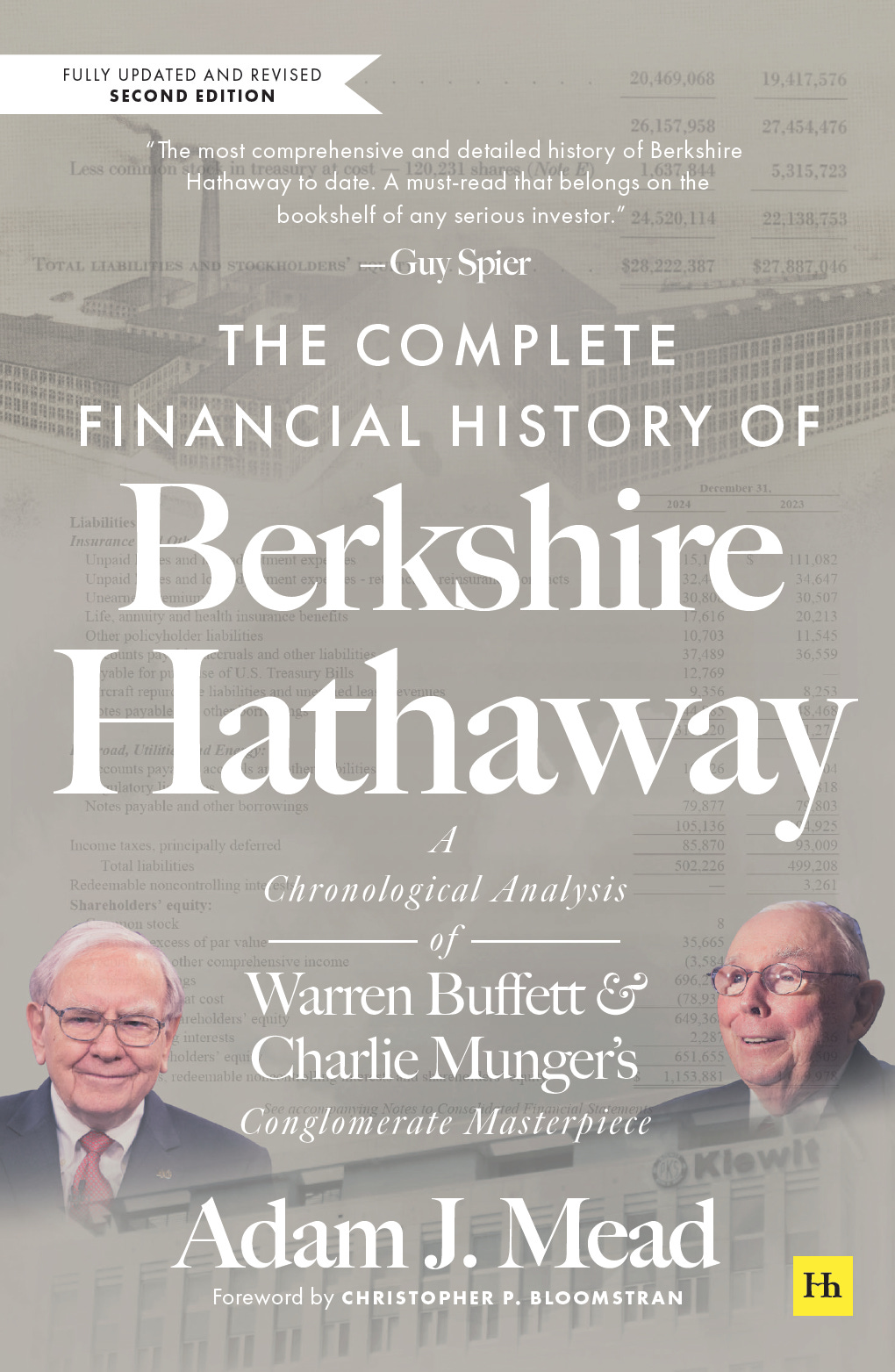
Pre-Order the 2nd Edition Now!
Amazon, Barnes & Noble, or directly from Harriman House, and at other major bookstores, for delivery in April 2026.
I'm guilty of wasting my time on things like this. My "timing" filter has been pretty bad: I did enjoy looking at some Intel/IBM/AT&T annual reports from the 70s, and Buffett has joked about reading Coca Cola reports from the 1800s.