


Can the Cash Flow Statement Lie?
Copart made two separate acquisitions of around $100 million that show up completely differently on the statement of cash flows.
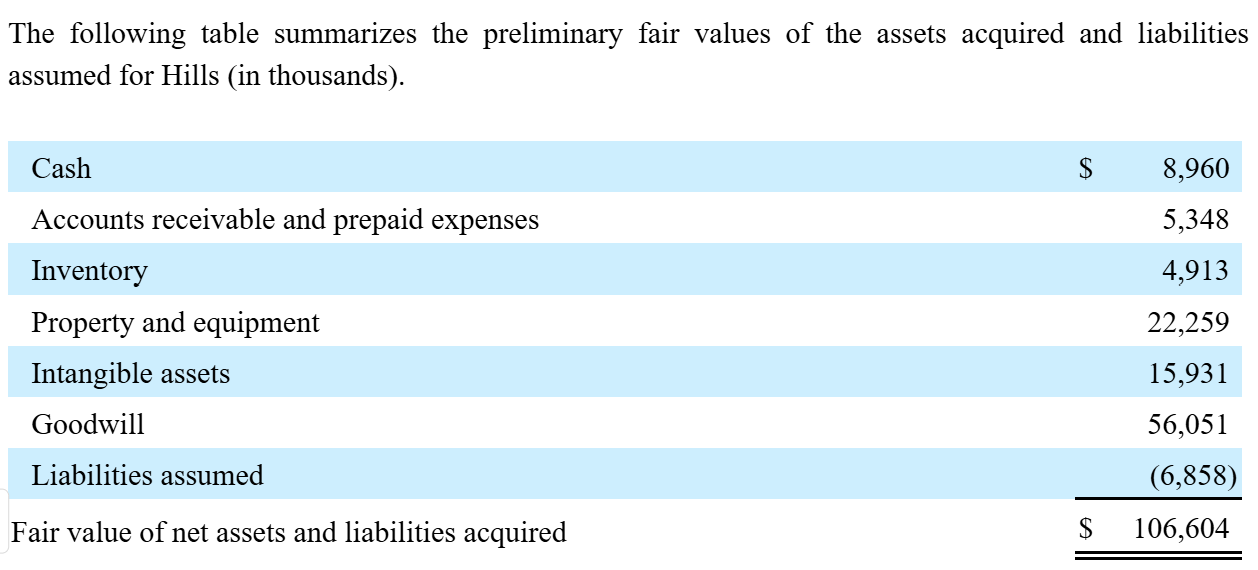
In 2022, it paid $106.6 million for Hills Motors, a UK-based parts recycler.
In 2024, it paid $112.1 million for 80% of Purple Wave, a heavy equipment auctioneer.
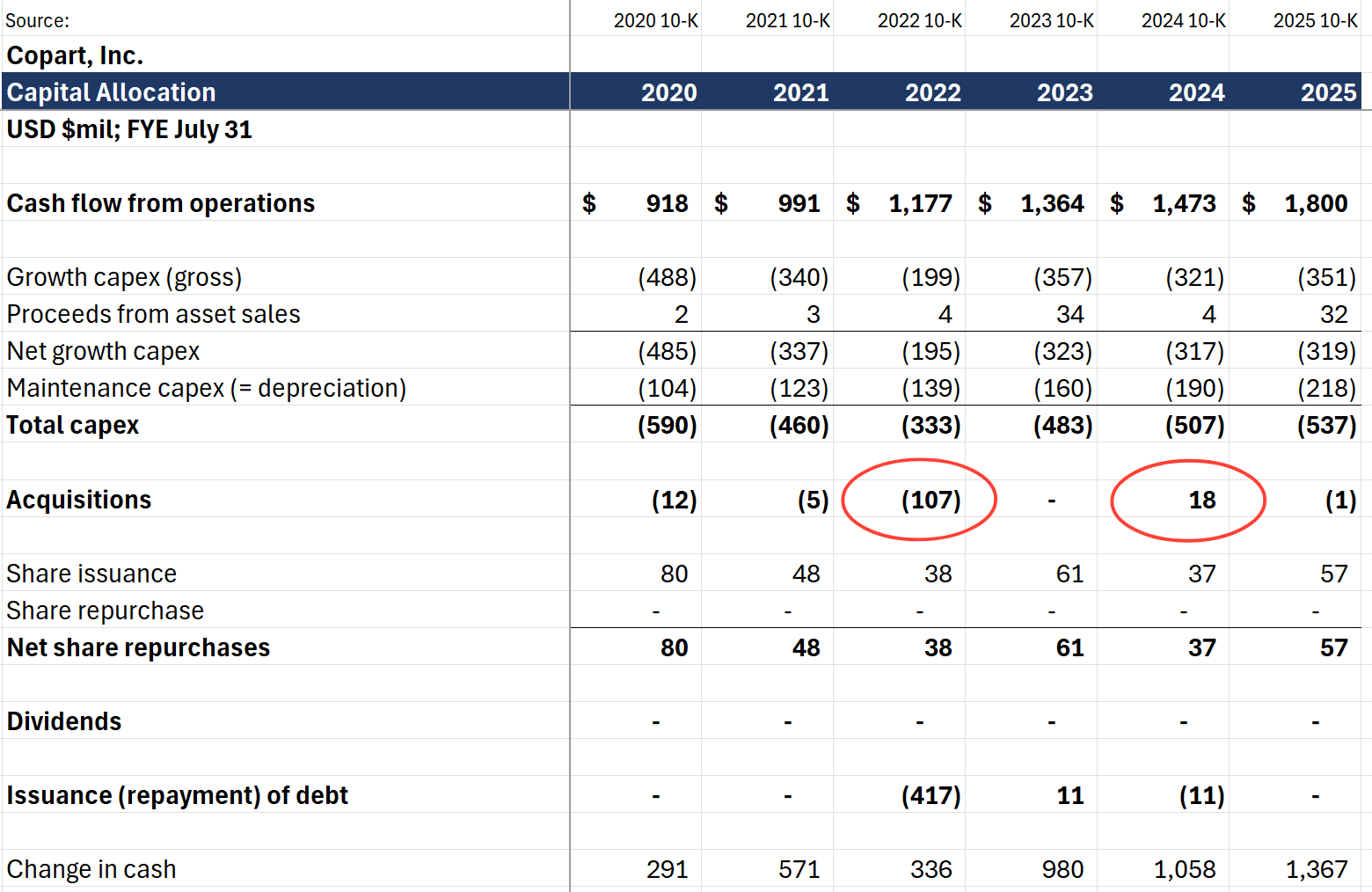
Now take a look at the acquisitions line in the snapshot below, which is taken directly from the CF statement. Negative numbers indicate cash out, so the ($107) lines up with Hills exactly (rounded, of course).
But what about Purple Wave? If this is to be believed, Copart received $18 million. What’s going on here?
All in a Name
This highlights a key limitation of the cash flow statement. It’s, ahem, cash-based…
The difference between the two acquisitions is that Copart paid cash for Hills and stock for Purple Wave. Purple Wave had $18 million of cash on the books at closing, and that cash had to be accounted for.
In an alternate reality where Copart purchased Purple Wave for cash but separately issued stock to fund the transaction, it would have shown cash out in the investing section and a cash inflow in the financing section.
The bottom line: Dig deeper to understand how an acquisition is financed and accounted for.
Going Deeper: Advanced Accounting
A few additional aspects of these transactions are worth noting for those willing to go deeper.
Deal Price vs. GAAP Price
Start with the purchase price of Purple Wave. Copart agreed to a price of $108 million for 80% of the company. The 2.5 million shares Copart issued resulted from the $108 million deal price divided by the 10-day volume-weighted average price of Copart’s stock.
But the GAAP fair value was determined based on Copart’s actual closing stock price on October 6, 2023. So for GAAP purposes, Copart paid $112.1 million.
Control vs. Noncontrolling Valuation
Next, let’s look at the implied valuation for 100% of Purple Wave. Frustratingly, we have three values to choose from:
$135 million: $108 million deal price / 80% = 100% interest
$140.1 million: $112.1 million GAAP price / 80% = 100% interest
$126 million: $25.2 million redeemable noncontrolling interest / 20% = 100% interest.
So which one is right?
The first two assume that the value of Copart’s controlling 80% stake applies to the noncontrolling interest. But the 20% noncontrolling interest, by definition, doesn’t have control.
Conversely, the third option assumes that the control discount doesn’t apply to the 80% control position.
One way to reconcile this is to add the $112.1 million fair value and the $25.2 million noncontrolling interest to get yet a fourth option: $137.3 million. This considers the valuation from both positions and incorporates the undisclosed terms of any redemption mechanics leading to the lower valuation of the noncontrolling interest.
Nothing But Net (Usually) - ASC 805
There’s another wrinkle in the accounting: the treatment of cash on the books of the acquired company. Companies usually report acquisitions net of acquired cash.
But take a look at Copart’s 2022 10-K, and you’ll find that Hills had $9 million in cash at closing. So it appears that Copart reported the gross value of the acquisition inclusive of cash.
From my research into the accounting standards, it appears that the typical presentation is to net the cash on the cash flow statement. So it probably should have been $97.6 million. In Copart’s case, the figure was nonmaterial.
Example: Boston Beer
Here’s a more typical example using Boston Beer’s 2019 acquisition of Dogfish Head.
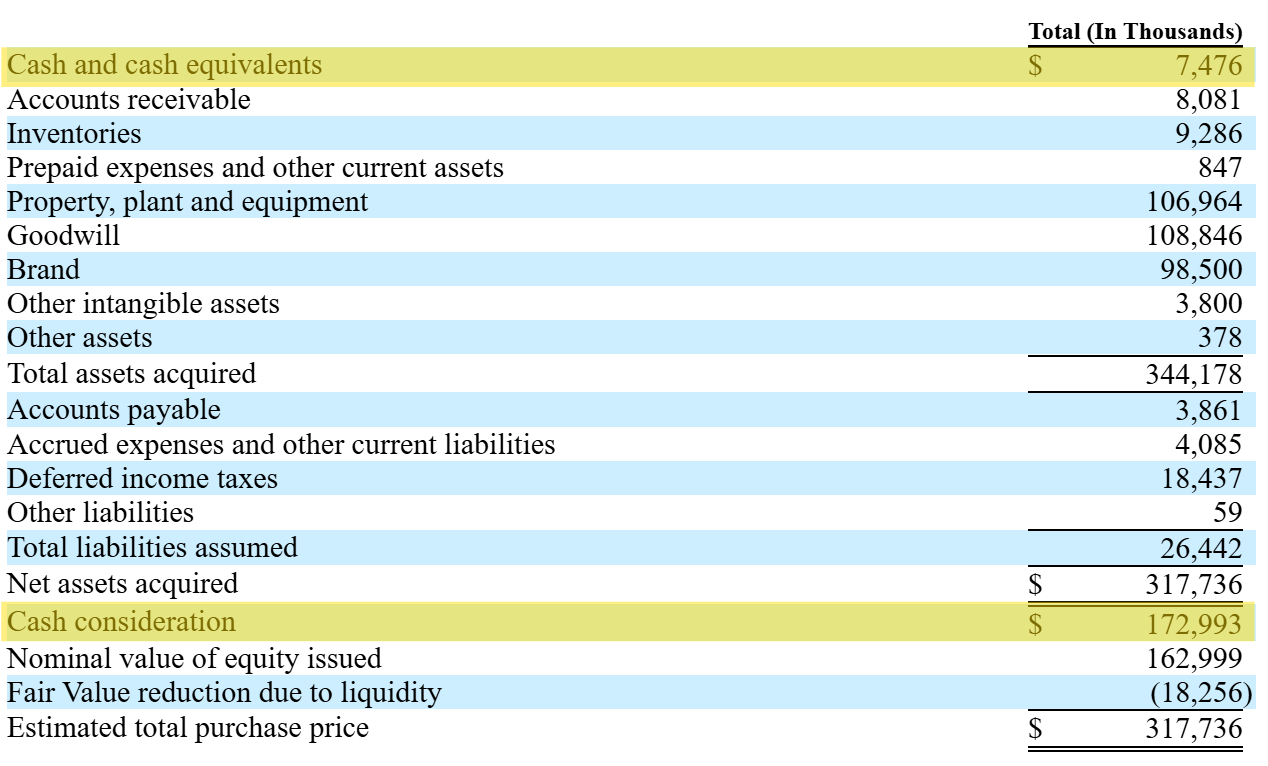
Boston Beer paid $336 million for Dogfish Head, with $173 million paid in cash and the remainder in stock.
From the allocation table (second snapshot), we can see the $173 million cash consideration and the $7.5 million cash that Dogfish Head had on its books at closing.
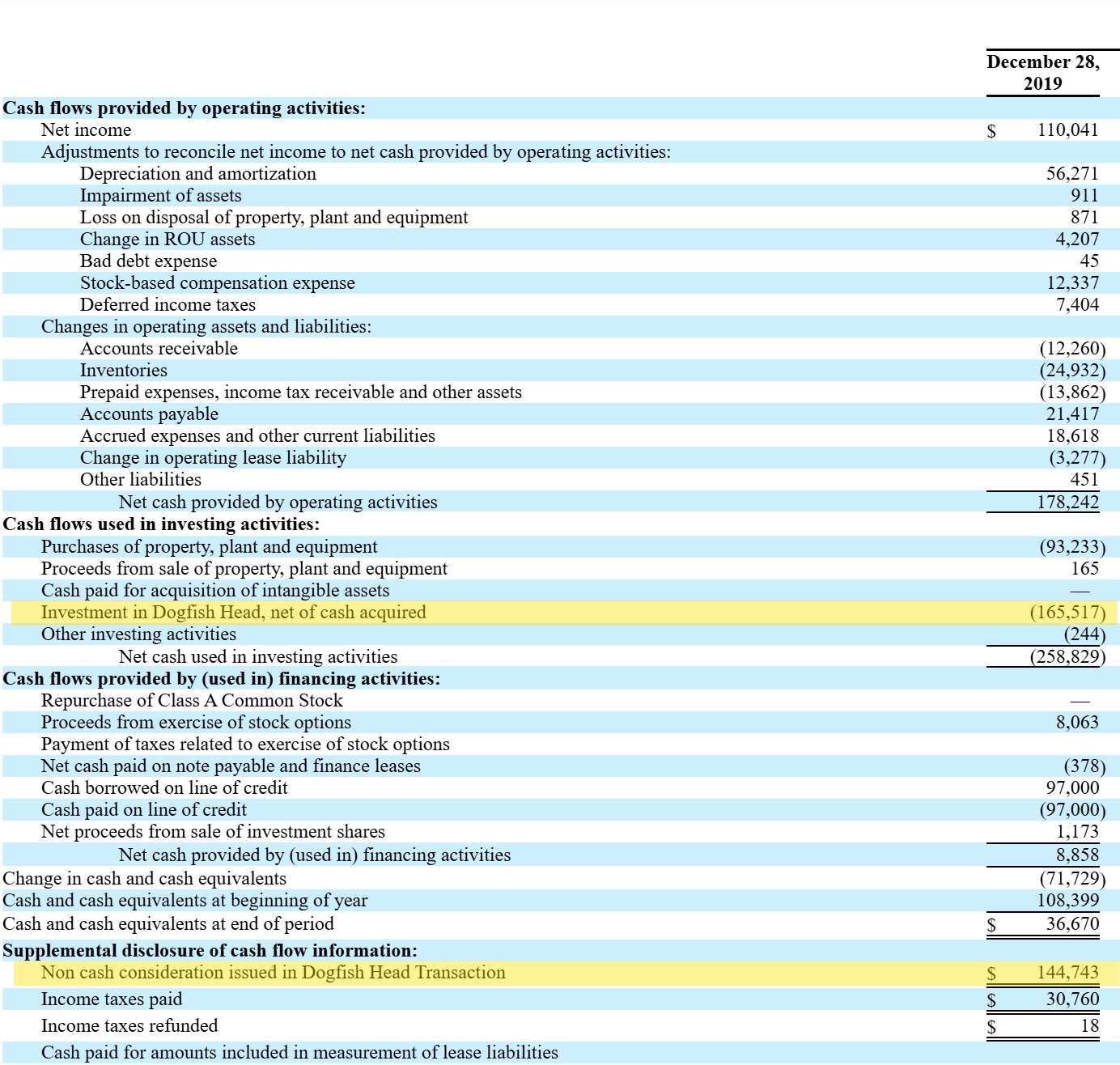
Boston Beer’s cash flow statement shows the exact difference between these two figures in “Investment in Dogfish Head, net of cash acquired” of $165,517,000
The company also gives us a nice supplemental disclosure showing the $144.7 million noncash consideration (shares) issued as part of the acquisition. The difference between the $163 million on the allocation table and the $144 million listed on the cash flow statement is an $18 million liquidity discount on shares issued to the sellers.
Conclusion
To wrap up this whole post, the key takeaway is to go deeper. Doing so can uncover a flurry of figures that at first glance can be confusing (such as the four ways to value Purple Wave). But a careful study of where the figures come from and how they reconcile can give you a deeper understanding of accounting and how to paint a better picture of the company you’re analyzing.
More thoughts? Let me know in a private message or leave a comment.
Stay Rational!
Adam
Order the 2nd Edition Now!
Praise for the 2nd Edition
I’m incredibly grateful for the people who took the time to review early drafts of the new material and provided feedback, as well as praise for both editions:
“If you want to understand how Warren Buffett built Berkshire Hathaway into one of the most valuable businesses in the world, you have to read this book. This is your opportunity to stand beside Picasso as he paints each brush stroke. A must read for all Buffett and Berkshire groupies.”
- Bill Ackman, Founder and CEO of Pershing Square
“I and my teammates at the Gabelli Organization have been tracking Warren’s success for some 50 years. Adam’s book captures the work and highlights the history of Berkshire and the hard and diligent work of Buffett and Munger, Jain and Abel, and Combs and Weschler.”
- Mario Gabelli, Chairman and CEO, Gabelli Funds
“Adam Mead’s discussion of the values and virtues which have shaped Berkshire Hathaway over 50 years is a must read for those investors in search of the forces that have delivered such investment value over time.” – Thomas A. Russo, Gardner Russo & Quinn LLC
“Few activities can be more rewarding for any value investor than studying the history and evolution of Warren Buffett and Berkshire Hathaway. Adam has done us a huge favor with his yeoman efforts in producing this treatise. Since it is chronologically ordered, it is an invaluable reference guide for all things Berkshire.” — Mohnish Pabrai
“Adam continues to deliver a resource very valuable to both Berkshire fans and the investor community as a whole, his depth of knowledge is clearly demonstrated here again. I thoroughly enjoyed this latest addition.” - Dan Calkins, Chairman & CEO, Benjamin Moore
“The question must be asked, ‘Why another Berkshire book?’ When you read this monumental effort by Adam Mead, the answer will be obvious. Read cover to cover, both the uninitiated to Berkshire and its most ardent followers will derive enormous utility and satisfaction from it. I learned so many new and important things about Berkshire and its history. It is my pleasure to encourage you to enjoy this gem.”
- Christopher P. Bloomstran
“Whatever Adam writes is always first-class - guaranteed.
-Andy Kilpatrick, Author, Of Permanent Value: The Story of Warren Buffett