

You can build an investment toolkit with any budget. In fact, I’d argue that you might be better off keeping your budget tight and putting the rest of your capital to work.
I split the investment process into four stages represented by a helpful acronym: FARM.
Find: Sourcing ideas / casting a wide net
Assess: A fast filter to screen the firehose of ideas
Research: The data collection and deep work necessary to bring an idea onto your watchlist and into your portfolio
Monitor: Alerts and ongoing work to stay on top of new information
Two Tools for 90% of the Process
Two tools cut across the entire spectrum. What’s more, they’re free.
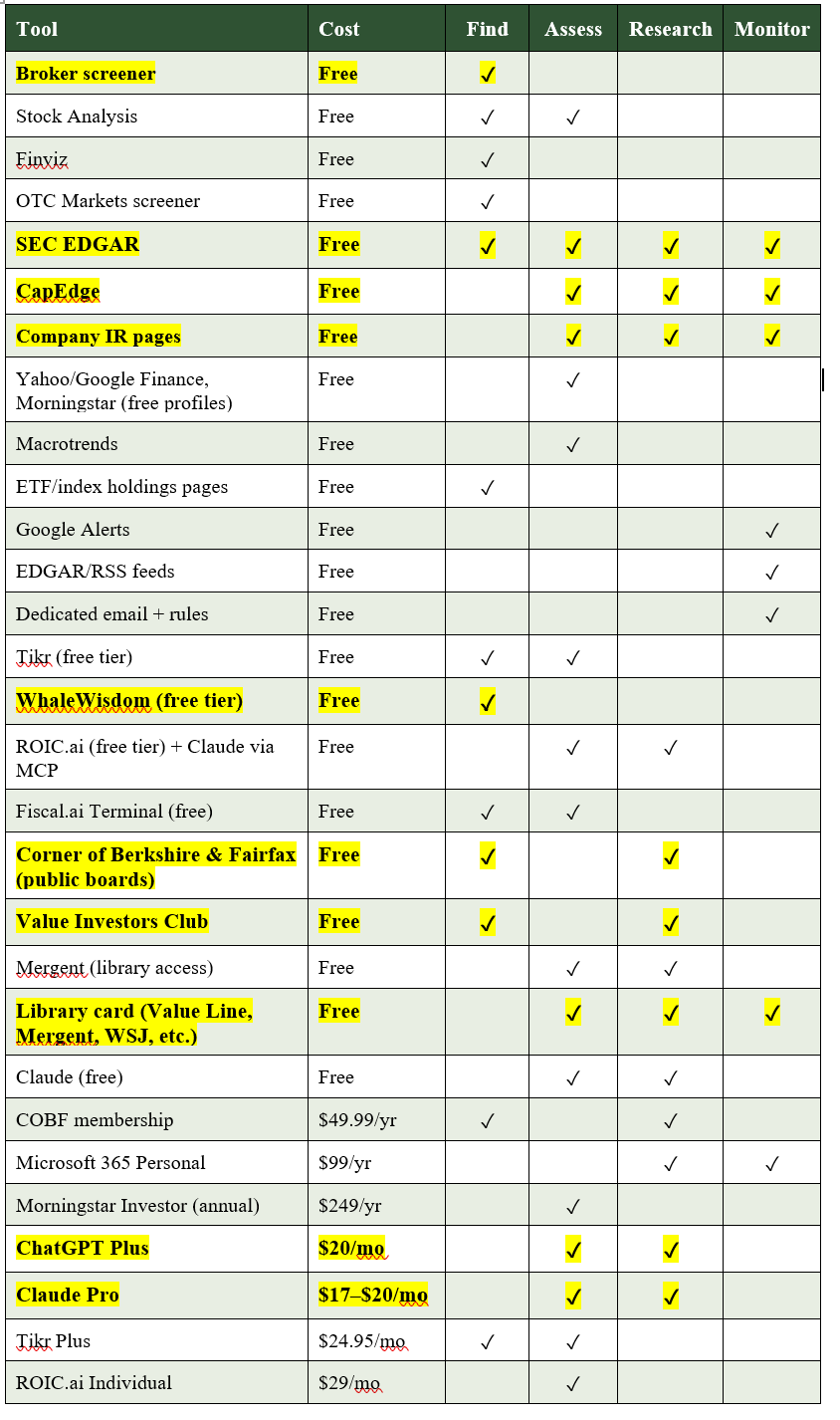
SEC EDGAR (link): For investors in US companies, the SEC’s filing site will be a primary source of information. Go ahead and bookmark it now. This is the central repository for all annual and quarterly statements (including the incorporated exhibits), proxies, insider transactions, debt filings, you name it.
Other countries have analogs, such as SEDAR in Canada, that I’d put here too.
CapEdge (link): This is a completely free tool I’ve built a lot of my processes around. It allows you to get notifications on new filings, search them (and compare redlined!), read transcripts, view historical financial data, and group companies in folders.
The Processing Layer
You’ll need what I call a processing layer. For most people, this will be Microsoft Office or Google’s products. I’m primarily an Office guy and do most of my work in Excel and Word. Excel is the workplace gold standard, and it makes beautiful charts.
I hesitate to assign a “research cost” to this because most people already pay for it anyway. Microsoft 365 for personal use is $99/year and gives you access to desktop apps, mobile, and 1TB of storage.
The next upgrade is Microsoft 365 Business for $14 to $22/month. Call it about $250/year. This lets you have multiple users, including your own email address, and lets you set up a ShareFile site, which is helpful for organization and collaboration.
Claude & ChatGPT: Your Research Assistants
Having used both products for a while now, there’s no going back. I pay $100/month for Claude and $20/month for ChatGPT, and it’s worth every penny.
Claude integrates with your desktop files, including manipulating them, and it works inside Excel and Word. You effectively have a research assistant or intern right there whenever you need it. Dispatch it on a mission to collect 10 years of annual reports, or input financial statements into your preferred format, or find articles, or check your reasoning. It’s wonderful.
I find ChatGPT a bit quicker on the draw with queries and a good thinking partner. It also does a good job remembering previous conversations.
The big asterisk and caution here is to use these as tools and be careful not to outsource your thinking.
Research Budgets: From $0 to $1,000 to $10,000/year
Tier 1: The Completely Free Stack:
Here’s what I’d do with no budget for research. You’d either have Microsoft Office already, or you could do very well with Google Docs/Sheets.
Broker search tools. Every broker has built-in search tools. There are many other free or free-tier sites that have great screeners. I won’t list them all.
To go deeper, CapEdge, SEC EDGAR, company IR pages, Fiscal.ai, ROIC.ai
WhaleWisdom’s free tier is all you need to view 13F filings from well-known investors
Quartr: This is a great source for conference calls. Unfortunately, it’s only available on mobile. They have other paid products as well.
Skip the free message boards such as Yahoo!. For higher-quality thoughts and analysis use Corner of Berkshire and Fairfax and Value Investors Club, both of which are free to lurk/browse.
Library Card: Seriously. Many libraries give you access to tools like ValueLine, Mergent, The Wall Street Journal, and many other publications.
Industry publications: You can find a lot off good articles for free. Some will even send you physical copies at no charge.
Tier 2: The Starter ($25-$50/month)
ChatGPT: The first thing I’d probably add is a ChatGPT upgrade. You’ll get access to agents and more bandwidth. While not as robust as Claude, ChatGPT will hold its own at building spreadsheets and working through data you give it.
Subscriptions: Even a serious amateur investor needs a good flow of news and ideas. Paid services like The Wall Street Journal (~$50/mo. after the intro rate) put you in the know and with a well-respected team of journalists sourcing and curating information. The Economist is also a great source of news and ideas delivered on a weekly basis. You might also add one or two Substack subscriptions from writers you admire to get exposure to their thinking and find new ideas.
Tier 3: The Serious Amateur ($100-$250/month)
Now we’re able to get a few more tools in the toolbox.
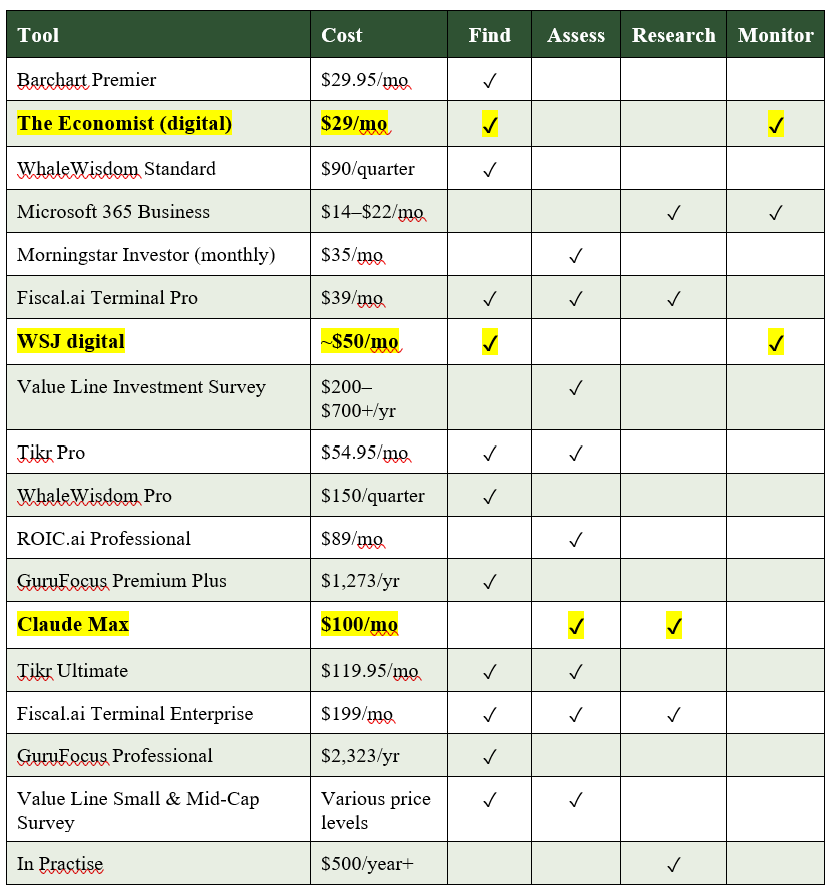
Claude Max: I’d go right to Claude Max at $100/month. If you’re doing serious research, you’re going to need some heavy-lifting power at your disposal. Especially if you’re limited on time, which who isn’t?
Subscriptions:
Wall Street Journal digital ($50/mo.)
Economist digital ($29/mo.)
Morningstar ($35/mo. or $249/year). Morningstar has its own research team and does a good job summarizing key updates for most large and mid-size companies. Full disclosure, I’ve used it for years, but I’m phasing it out as I’m not getting enough out of it lately.
Other Paid Tools: I use a whole suite of free versions of tools from time to time. That includes TIKR, Fiscal.ai, ROIC.ai, and WhaleWisdom, among others. You might find you particularly enjoy or spend a lot of time on them, and that might be a reason to upgrade to the paid versions.
Industry Publications: Now you might want to upgrade your industry “rags” budget to include some specific publications that give you a pulse on one or more industries.
Tier 4: Full Stack / Professional ($300-$600/month) or more
You can certainly spend a fortune on tools, but you don’t need to. You’d be surprised at how relatively small my budget is.
Tools:
Claude Max ($100/mo.).
Microsoft 365 for Business
Subscriptions/Research:
Wall Street Journal
Economist
ValueLine Investment Survey ($200-$700+ per year)
Substack subscriptions
InPractise: Insider interviews. I used to pay for this but found I didn’t use it enough.
Additional industry publications
Note that I’ve left off several tools mostly because I haven’t used them (or don’t want to pay for them). These include Bloomberg, AlphaSense, and others that run from $5,000 to $25,000 per year or more.
Concluding Thoughts
There are so many free sources of investment information today. You can build a great process with a small budget and put your savings to work in your portfolio instead.
And sure, AI is here and can do an incredible amount of impressive work and research. But that’s not enough. I believe it’s going to come down to the same thing it always does: doing the work. There’s no substitute for sitting down and thinking about what’s in front of you, whether that’s your own spreadsheet or one put together by AI.
Taking the time to build a solid and repeatable research process is worth the effort. It will build and hone skills that allow you to better utilize the tools at your disposal. And AI isn’t perfect. Far from it. Knowing how a spreadsheet should look and analyzing its outputs requires human understanding. Otherwise, how can you have the confidence to put real money to work?
Value Investing Course
I’m building a self-directed value investing course that will teach you how to become a better investor. It’s a system you can start using today to do real research.
While it’s still in beta testing, you can purchase lifetime access starting now.
More thoughts? Let me know in a private message or leave a comment.
Stay Rational!
Adam
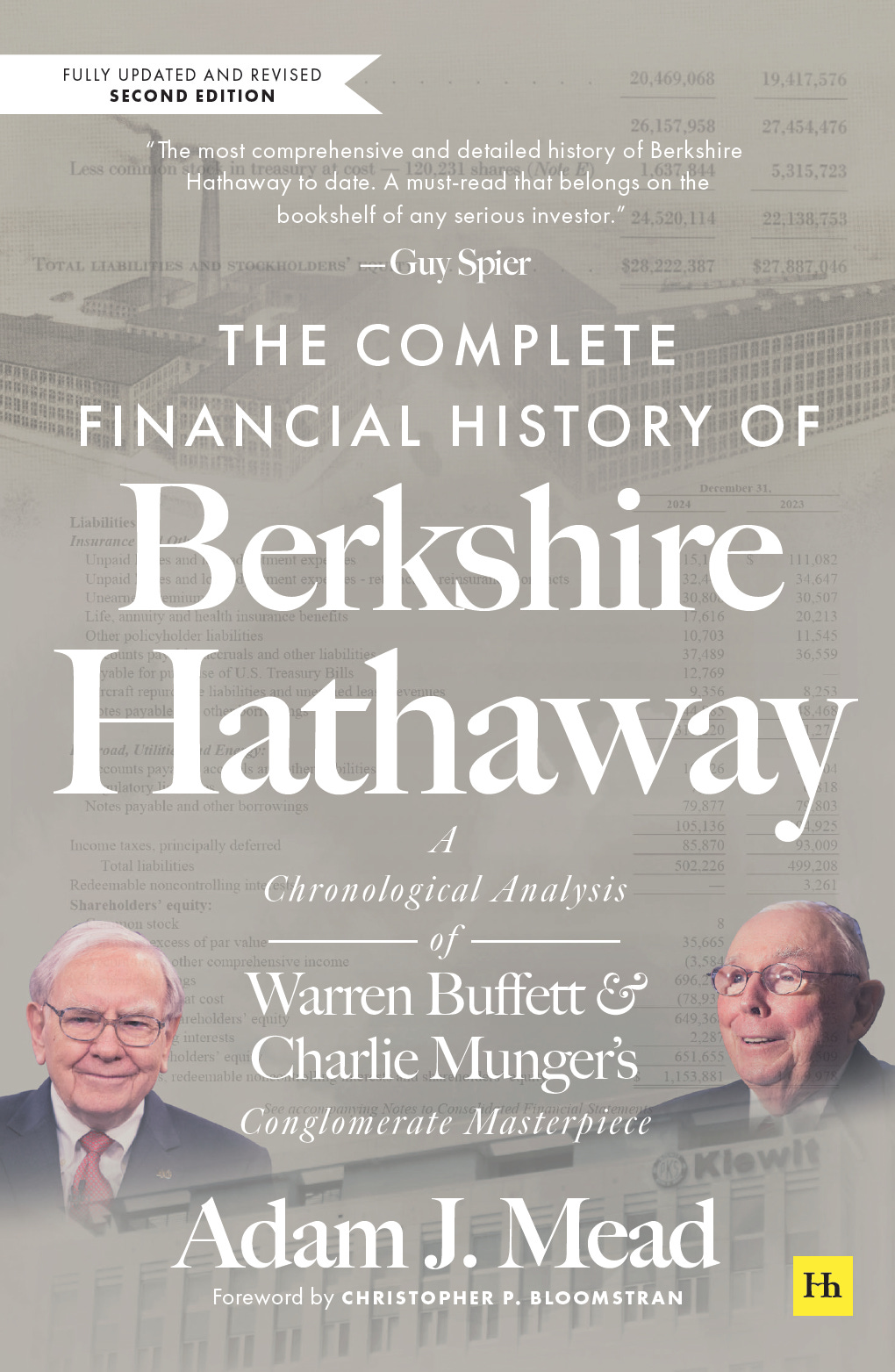
Order the 2nd Edition Now!
Praise for the 2nd Edition
I’m incredibly grateful for the people who took the time to review early drafts of the new material and provided feedback, as well as praise for both editions:
“If you want to understand how Warren Buffett built Berkshire Hathaway into one of the most valuable businesses in the world, you have to read this book. This is your opportunity to stand beside Picasso as he paints each brush stroke. A must read for all Buffett and Berkshire groupies.”
- Bill Ackman, Founder and CEO of Pershing Square
“I and my teammates at the Gabelli Organization have been tracking Warren’s success for some 50 years. Adam’s book captures the work and highlights the history of Berkshire and the hard and diligent work of Buffett and Munger, Jain and Abel, and Combs and Weschler.”
- Mario Gabelli, Chairman and CEO, Gabelli Funds
“Adam Mead’s discussion of the values and virtues which have shaped Berkshire Hathaway over 50 years is a must read for those investors in search of the forces that have delivered such investment value over time.” – Thomas A. Russo, Gardner Russo & Quinn LLC
“Few activities can be more rewarding for any value investor than studying the history and evolution of Warren Buffett and Berkshire Hathaway. Adam has done us a huge favor with his yeoman efforts in producing this treatise. Since it is chronologically ordered, it is an invaluable reference guide for all things Berkshire.” — Mohnish Pabrai
“Adam continues to deliver a resource very valuable to both Berkshire fans and the investor community as a whole, his depth of knowledge is clearly demonstrated here again. I thoroughly enjoyed this latest addition.” - Dan Calkins, Chairman & CEO, Benjamin Moore
“The question must be asked, ‘Why another Berkshire book?’ When you read this monumental effort by Adam Mead, the answer will be obvious. Read cover to cover, both the uninitiated to Berkshire and its most ardent followers will derive enormous utility and satisfaction from it. I learned so many new and important things about Berkshire and its history. It is my pleasure to encourage you to enjoy this gem.”
- Christopher P. Bloomstran
“Whatever Adam writes is always first-class - guaranteed.
-Andy Kilpatrick, Author, Of Permanent Value: The Story of Warren Buffett
Solid breakdown of the essential toolkit. SEC EDGAR is absolutely the bedrock of any serious process. I always start with the raw 10-Qs before looking at any pre-packaged screener data. The biggest risk with the current wave of AI tools is the temptation to completely outsource our thinking. If the business model doesn't make logical sense in everyday life, even the most sophisticated Claude prompt won't save us from a value trap. Doing the manual forensic work builds the actual conviction needed to hold through a severe drawdown. A necessary reminder to stick to the roots.
Flo ✌🏻
I don;t have budget
i get FREE SEC database
is there something wrong?