


Note: This is the second in a series of “how-to” posts exploring the investment process.
Why Most Investors Waste Time on Bad Ideas
My Experience Finding Medifast
Last week, I wrote about the problem of filtering. Here, I want to show how that process worked in practice using Medifast, a company I eventually added to my portfolio.
Your search process will give you a list of stocks to assess. It might be a handful of names or hundreds.
I’ll tackle the problem of generating ideas in a future post.
410 Stocks to Assess
My initial list of companies came from the 2024 Russell Reconstitution lists. There were 212 additions and 198 deletions from the index for a total of 410 companies to sort through.
Even taking one minute per company would require almost a full day’s worth of work. That’s not unreasonable given the potential, but I needed to winnow it down.
Microsoft’s Stock Function

The first thing I did was put the tickers into Excel. The built-in Stock function pulls description, industry, and market cap, and can include other attributes, too. But those three are enough to make quick judgments.
You can then easily create a sortable table for filtering. This is especially useful if you’re only looking for companies from certain industries.
Iterative Filtering - The First Pass (30 sec to 1 min)
I tend to go through a list like this a few times. The first is to filter out the companies I clearly don’t want to look at, putting the principle of inversion to good use.
For me, that’s usually biotech, startups, mining companies, non-bank financials, etc.
I have a column in the spreadsheet to put a note or simply an “X” to mark that I’ve eliminated it, which allows me to filter those out in subsequent passes.
This step probably eliminated a good 75% of the list, or about 300 companies.
Flash Financials - Going Deeper (3-5 mins)
The next step is to start scratching the surface to understand the opportunity.
You might already have an idea of the company’s financials if you’ve screened along certain metrics (low debt/equity, high ROE, etc.) Either way, you need to quickly size up the company.
Here I’ll turn to CapEdge or ROIC.ai to get a quick financial snapshot.
Major red flags at this point include highly indebted companies, those with little to no revenue history, lots of red ink on the bottom line, etc. When I find a red flag like that, I stop and move on. Time is precious!
Here’s what my five-minute assessment of Medifast turned up:
$156 million cash + investments compared to a market cap of $270 million
No debt, only minor operating leases
Price/book value of 1.3x
$100mm earnings in 2023 (the last full year then available) and $67mm TTM profits through Q1.
Sales had grown from $500mm in 2018 to $1.6 billion in 2022, only to decline by a third to $1 billion in 2023.
The quick 5-minute assessment was roughly as follows:
Here’s a company clearly undergoing a significant change in its operating environment, with sales down by a third in one year. Yet, the company remains profitable. Furthermore, it has a very strong balance sheet with loads of liquidity and essentially no debt.
At this point, I had lots of questions, but I was intrigued. I knew basically nothing about the weight loss industry aside from general reading that GLP-1 medications were highly disruptive.
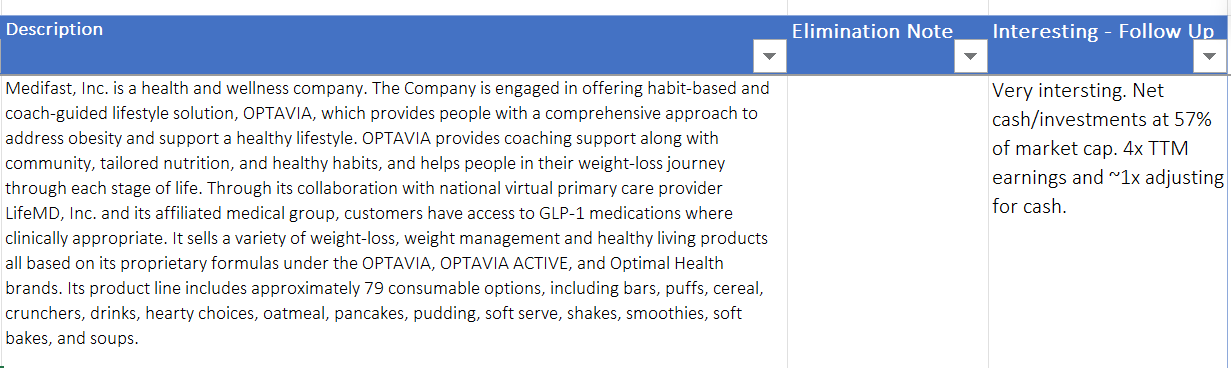
Below is a snapshot of the actual spreadsheet, including my note, from 2024. The description is auto-populated with the stock function. The two columns on the right are my “discard” and “keep going” columns to sort my findings.
Scanning the 10K (5 mins)
I was down to about a dozen companies after going through a similar process with the remaining 100 or so companies on my list. Now it was time to peek under the hood at the latest 10K or annual report.
I pulled up Medifast’s 2023 annual report and started scrolling through:
Just a few pages of marketing fluff at the beginning
A letter to shareholders was present. I took a few minutes to read through the letter, noting the substance-to-marketing ratio. Some letters are clearly written by the marketing department, a disservice to investors.
A scan through the business section of the 10K (Item 1. Business in every 10K) led me to believe I understood the basic business model of the company.
The Decision Point
By now, I had completed an initial assessment of Medifast, investing about 10 minutes of my time.
Since it wasn’t something in my “don’t want” list, it passed the first filter.
Then, a quick assessment of the financials didn’t turn up any red flags. Seeing the large amounts of cash and no debt made me even more interested in digging in.
Finally, a quick scan of the annual report found a letter to shareholders and a business description that led me to believe I could understand the business if I dug in further.
Weighing the other opportunities I’d found against this initial assessment, I decided that it made sense to move into the research phase and conduct a proper deep dive. Given that Medifast had loads of excess cash and appeared to be trading a single-digit multiple of earnings, I fast-tracked my research and ended up buying shares (wrong timing in retrospect, but the jury is still out).
Applying The Four Filters
I didn't apply the four filters in order, but I applied all of them.
Filter #1: Can I understand it?
I answered this question multiple times throughout my assessment. In the initial description of the company, and as I read through the letter to shareholders and the business description in the 10K.
Filter #2: Is it a good business?
I didn’t have enough information to know at this point, but I had clues. First off, the presence of lots of cash means it had been profitable in the past. Second, it was very profitable in the few years leading up to my finding the company. Third, it appeared that the company had a highly variable cost structure that could protect it from sales declines.
Filter #3: Is anything obviously wrong?
I had to weigh the clear impact of GLP1s with the opportunity to buy a company at a distressed price. But I didn’t find any major red flags in my initial assessment that would lead me to abandon my research efforts.
Filter #4: Timing / Is There a Reason to Care Now?
The market was clearly pricing Medifast at distressed prices. This was a company I wanted to research deeper immediately to be in a position to take advantage of Mr. Market.
This example shows what a good filtering process looks like in practice.
What does your first-pass filtering process look like? Let me know in the comments.
More thoughts? Let me know in a private message or leave a comment.
Stay Rational!
Adam
Pre-Order the 2nd Edition Now!
Amazon, Barnes & Noble, or directly from Harriman House, and at other major bookstores, for delivery in April 2026.
I always find it useful to take a quick look at what the company's competitors are doing. Sometimes they're all facing the same problems and sometimes it's a company specific issue.
Thanks for sharing! It would be great to see how you approach a valuation from scratch—where you focus, what you look for in a 10-K, how you understand the business and its history, whether you read everything, and where you get your numbers (manually or using tools). Starting is always the tricky part, and I find that I often get lost in unhelpful details.