

Disclosure: Long
Copart is getting interesting again.
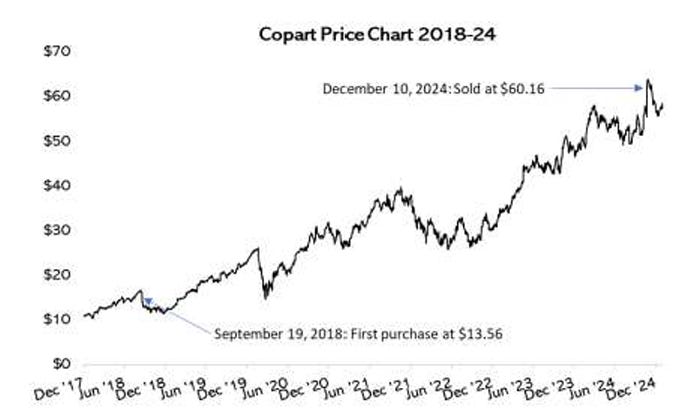
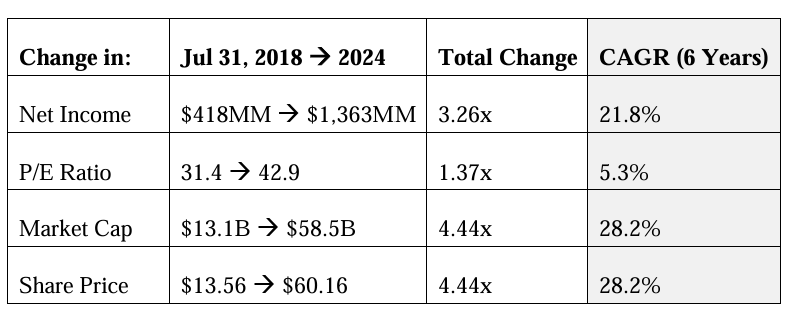
I first bought shares in 2018. The business itself grew substantially over the next few years, with a nearly 22% CAGR in net income through 2024. Then the stock price far outpaced the underlying business and traded north of 40x earnings.
I made the decision to sell at a price of $60, implying a market cap of $58.5 billion.
Shares today traded at $33.25, implying a market cap of around $32 billion.
Below are some comments on recent operating performance and capital allocation, and my thoughts on valuation.
Operating Update
Copart’s Q2 results showed weak comps due to catastrophe events in the prior periods.
Additionally, the high price of insurance is causing consumers to reduce coverage, increase deductibles, or drop their vehicle insurance altogether. Management views this as a cyclical trend and points to higher average selling prices and strong auction liquidity as offsetting factors.
Global insurance units fell 9.3% (4.1% excluding CAT) and ASPs increased 6% reported or 7.1% ex. CAT.
Reported Q2 revenue declined 3.6% to $1.12 billion but increased 1.3% excluding CAT. Operating income declined 8.8% to $388.7 million for the quarter.
In the US, insurance units fell 10.7% (4.8% ex. CAT), leading to a 9.5% overall decline in units (4.5% ex. CAT). US operating margin came in at 37.1%.
International units were down less than 1%, and insurance units fell 2.6% (down 1% ex. CAT). ASPs increased 9%. International operating margin came in at 23.6%.
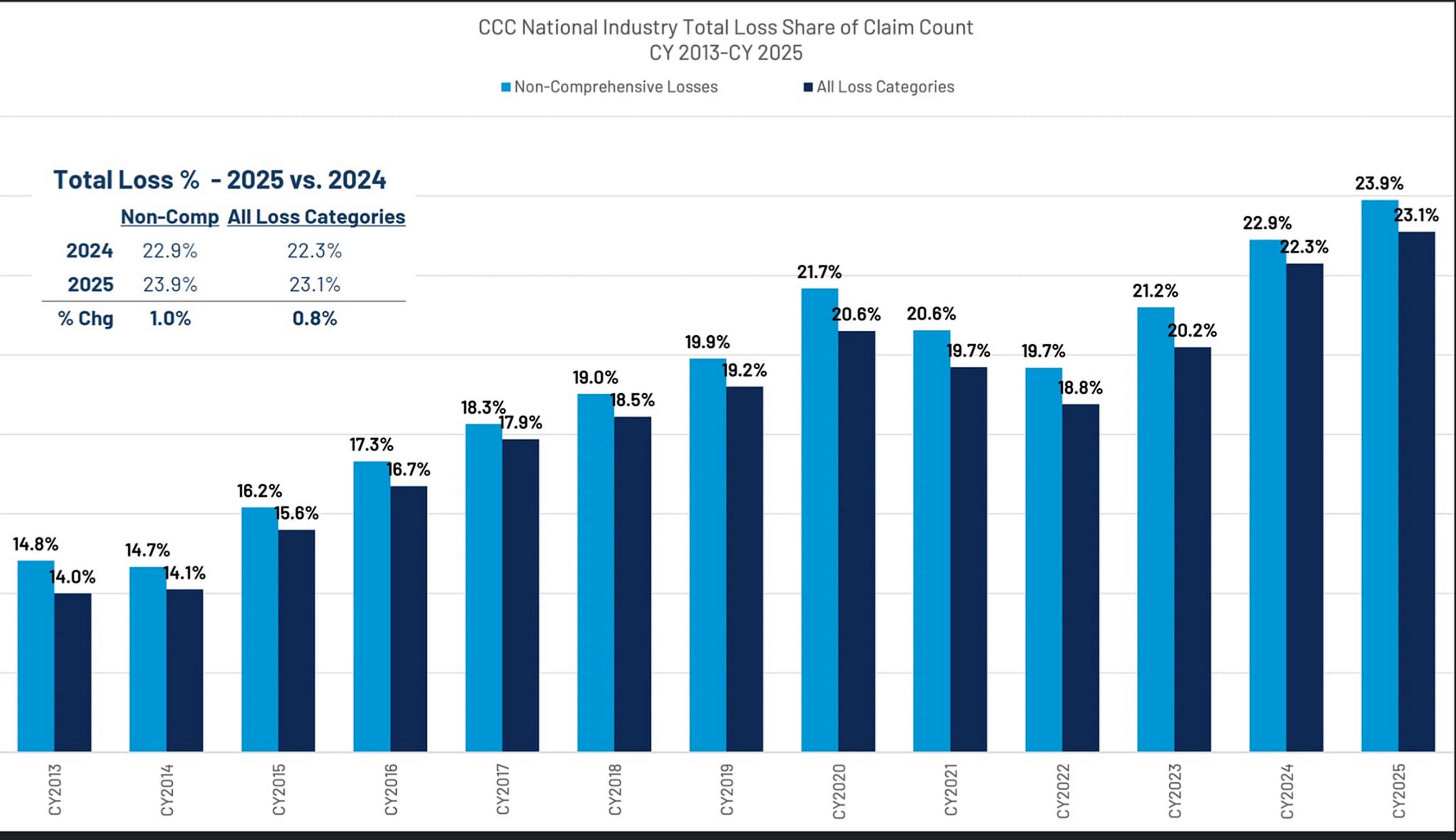
Total loss frequency in the US was 24.2% in calendar Q4 2025. Management pointed to the longer-term trend and noted that frequency had increased from 15.6% in 2015 to 23.1% for calendar 2025. Here’s updated data from CCC:
Purple Wave (heavy equipment) transaction volume increased 17% LTM.
Buybacks Resume
The company bought back shares for the first time since 2019, spending $218.2 million to repurchase 5.5 million shares at an average price of $39.82/share. But wait, there’s more…
After quarter end, the company repurchased an additional 24.3 million shares at an average price of $37.11/share for $898.7 million.
Analysts had been badgering the company to repurchase shares for years, and the company resisted (rightly), implying prices weren’t favorable. As a result, cash piled up on the balance sheet, reaching $5.1 billion at the end of Q2. The company has no debt and just $96 million of lease liabilities, so the balance sheet is pristine and primed to take advantage of the stock price decline.
Valuation
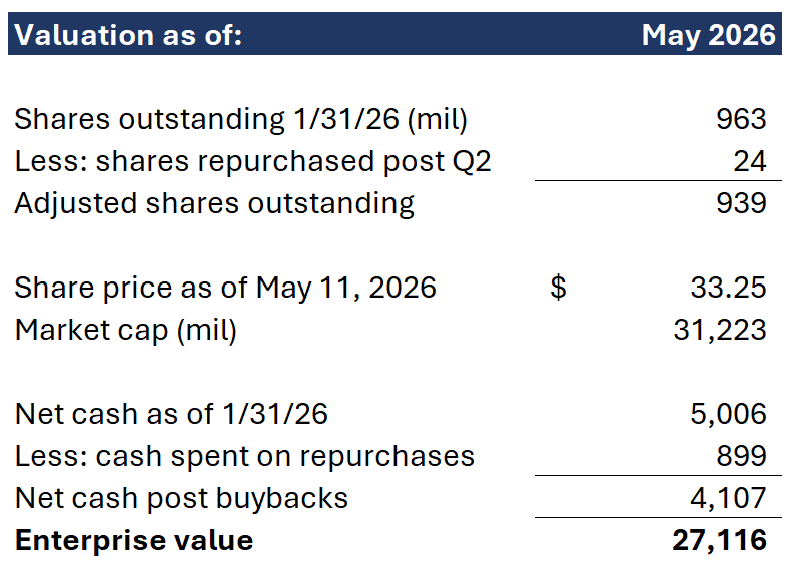
Adjusting for the share repurchases after Q2 close, Copart has an enterprise value of $27 billion.
TTM EBIT is $1,684 million, which puts the EV / EBIT multiple at 16.1x.
Viewed another way, after 25% tax, NOPAT is $1,263 million, which translates into a 4.65% earnings yield (21x after-tax earnings). Such a valuation would imply about 5-6% growth to justify. Looking at Copart’s history, that’s a moderate bar to clear.
Here’s how those numbers play out: Copart employs approximately $5 billion of capital in its business (i.e., adjusted for cash). To grow 6% would require $300 million. This also seems like an amount management could reasonably add to the balance sheet, given its recent history. Assuming normalized earnings power of $1.3 billion, the distributable cash flow is $1 billion (growth requires capital, in this case $300 million). With a 10% discount rate and 6% growth, the $1 billion is worth 25x or $25 billlion. Plus the cash of $4 billion = ~$29 billion. If growth is 5%, then the value falls to $25 billion. So the question is all about future growth.
I see potential in several areas:
Continued frequency gains and a return to normalized insurance coverage
European margin improvement
International volume growth could extend the reinvestment runway
Heavy equipment could expand TAM, though this could come at a lower incremental ROIC, given the need for additional infrastructure
Considering all of the above, I think Copart is selling at a fair price. Management has proven itself capable and shareholder-friendly, always looking decades ahead and building the business for the long term.
More thoughts? Let me know in a private message or leave a comment.
Stay Rational!
Adam
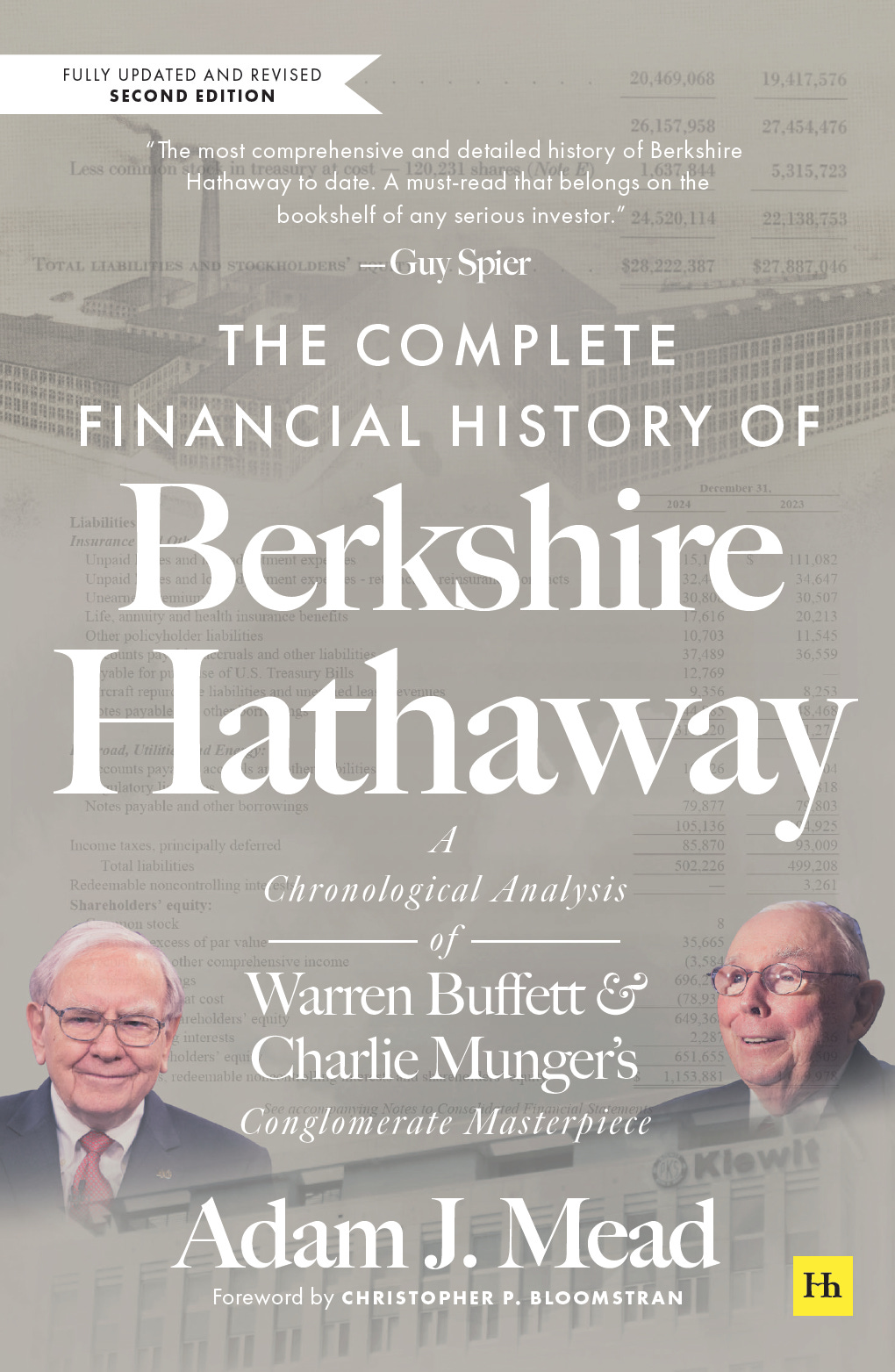
Pre-Order the 2nd Edition Now!
Amazon, Barnes & Noble, or directly from Harriman House, and at other major bookstores, for delivery in April 2026.
Praise for the 2nd Edition
I’m incredibly grateful for the people who took the time to review early drafts of the new material and provided feedback, as well as praise for both editions:
“If you want to understand how Warren Buffett built Berkshire Hathaway into one of the most valuable businesses in the world, you have to read this book. This is your opportunity to stand beside Picasso as he paints each brush stroke. A must read for all Buffett and Berkshire groupies.”
- Bill Ackman, Founder and CEO of Pershing Square
“I and my teammates at the Gabelli Organization have been tracking Warren’s success for some 50 years. Adam’s book captures the work and highlights the history of Berkshire and the hard and diligent work of Buffett and Munger, Jain and Abel, and Combs and Weschler.”
- Mario Gabelli, Chairman and CEO, Gabelli Funds
“Adam Mead’s discussion of the values and virtues which have shaped Berkshire Hathaway over 50 years is a must read for those investors in search of the forces that have delivered such investment value over time.” – Thomas A. Russo, Gardner Russo & Quinn LLC
“Few activities can be more rewarding for any value investor than studying the history and evolution of Warren Buffett and Berkshire Hathaway. Adam has done us a huge favor with his yeoman efforts in producing this treatise. Since it is chronologically ordered, it is an invaluable reference guide for all things Berkshire.” — Mohnish Pabrai
“Adam continues to deliver a resource very valuable to both Berkshire fans and the investor community as a whole, his depth of knowledge is clearly demonstrated here again. I thoroughly enjoyed this latest addition.” - Dan Calkins, Chairman & CEO, Benjamin Moore
“The question must be asked, ‘Why another Berkshire book?’ When you read this monumental effort by Adam Mead, the answer will be obvious. Read cover to cover, both the uninitiated to Berkshire and its most ardent followers will derive enormous utility and satisfaction from it. I learned so many new and important things about Berkshire and its history. It is my pleasure to encourage you to enjoy this gem.”
- Christopher P. Bloomstran
“Whatever Adam writes is always first-class - guaranteed.
-Andy Kilpatrick, Author, Of Permanent Value: The Story of Warren Buffett
“With this project, Adam has done a wonderful job extending the Berkshire Classroom by providing a comprehensive analysis of the rich corporate history and unique entrepreneurial leadership.” — Mac Sykes, Gabelli Funds
“Adam Mead’s The Complete Financial History of Berkshire Hathaway is the definitive history of Berkshire. While there have been countless books written about Warren Buffett’s investment approach, none have so meticulously documented Berkshire’s capital allocation decisions from the very beginning. The depth of research is staggering, transforming the complex and sometimes chaotic story of how a small textile mill became a financial conglomerate into a clear, year-by-year narrative of every significant investment and acquisition. In this updated edition, Adam carries the narrative through Berkshire’s sixth decade and the methodically planned leadership transition to Greg Abel. For students of business history, this is an indispensable resource.”
-Patrick Gaughen, President and Chief Operating Officer, Hingham Institution for Savings
“The definitive story of Berkshire Hathaway—how Buffett and Munger turned a failing textile mill into one of history’s greatest wealth-creating enterprises, with timeless lessons in business, investing, and leadership.”
-Vitaliy Katsenelson, CEO of IMA, Author of Soul in the Game
“Berkshire Hathaway is a company with few, if any, parallels in business history. Under the leadership of Warren Buffett, it was transformed from a New England textile mill that would ultimately be shuttered to a sprawling conglomerate with a market valuation of more than $1 trillion. With this updated edition of “The Complete Financial History of Berkshire Hathaway”, Adam provides a thorough review of the key decisions that created the modern Berkshire Hathaway, an outcome inextricably tied to the investment and business wisdom of Warren Buffett and his business partner, Charlie Munger. In a few hundred pages, Adam adeptly runs through six decades of Berkshire’s history. For Buffett and Munger fans who want to truly understand how Berkshire was created, this book is a must read.”
- Alex Morris, Founder of TSOH Investment Research and the Author of Buffett & Munger Unscripted
“A meticulous chronicle of Berkshire Hathaway’s remarkable final act under Buffett’s leadership. Mead’s granular analysis of Buffett’s capital allocation decisions—from the $78 billion in share repurchases to the masterful Apple investment—provides unmatched insight into how the world’s most successful conglomerate navigated unprecedented scale and succession challenges.”
-Tobias Carlisle, Portfolio Manager, Acquirers Funds®
“This exceptional history of Berkshire Hathaway will appeal to history buffs, finance enthusiasts, and investing professionals alike. Mead combines rigorous research with remarkably clear storytelling, tracing the company’s ascent from a struggling textile mill to one of the world’s most admired conglomerates. The book is impressively detailed yet fully accessible—equally valuable for students learning the foundations of investing and for seasoned professionals looking to deepen their understanding of Berkshire’s evolution.”
-Gillian Zoe Segal
“With his ability to make complex things seem simple, Warren Buffett made the difficult work of building Berkshire Hathaway look easy. With this excellent history, Adam Mead takes us behind the scenes to see the details of how that work happened and was so successful. For anyone interested in Berkshire Hathaway, or the development of American capitalism, this is essential reading.”
- Bryan Lawrence, Founder, Oakcliff Capital
“There is simply no book that details the economic lore of Berkshire Hathaway better. A true exposé that every intelligent investor should read.”
- Gwen Hofmeyr, Founder, Maiden Financial
“The most comprehensive book on Berkshire Hathaway that has ever been written. It belongs on the shelf of every business enthusiast!”
-Andrew Wagner, Author of the Economics of Online Gaming and Founder & Chief Investment Officer of Wagner Road Capital Management
“Adam’s accounting of the Financial History of Berkshire is like candy for Finance and Business Junkies alike. It’s a must read if you’re interested in studying the greats.”
- Carter Johnson, Managing Partner, Singleton Valuations
“I thought nothing else of value could be written about Warren Buffett. I was wrong. Adam’s detailed chronology of Berkshire’s evolution reveals the successes and failures of Warren in a unique and digestible way. A worthwhile read for every Buffett scholar, amateur and professional alike.” — Drew Estes, Banyan Capital
“Mead has done the Berkshire faithful an incredible service by stitching together the narrative and numbers so tightly, you can see the compounding in action—updated and genuinely useful.”
-Jacob Taylor, CEO of Baserate
“Adam Mead’s work reminds us that true value is found not just in numbers, but in the lasting quality where few care to linger. By doing exceptional due diligence his book clones the lessons of Warren and Charlie.”
-Jeff Gilbert
Adam Mead’s updated “Complete Financial History of Berkshire Hathaway” is a book like no other—chronicling six decades of evolution while reminding us that Berkshire, though Buffett’s masterpiece, remains subject to constant change—an indispensable addition to any serious investor’s bookshelf.
-Bogumil Baranowski, Founder of Blue Infinitas Capital, Author of “Money, Life, Family”, Host of Talking Billions Podcast
Thanks for a great write up Adam. Interesting that CEO Liaw has sold personal shares this year (January and April?). Guess the buyback plan is more relavent to shareholders- but it's always nice to see CEOs handling personal holdings similarly.
Any comments on the ceo transition?