


Copart Update
Disclosure: Long CPRT (prior analysis)
On September 10, Copart released its Q4 and Fiscal 2026 earnings and announced the largest acquisition in the company’s history. All in a day’s work, I guess.
The Q4 results were uninspiring, but there’s more going on beneath the surface. Then there’s the $1.9 billion acquisition of ACV…
ACV Auctions
Copart and ACV will combine in a friendly cash transaction that values ACV at $1.9 billion. Enterprise value = equity value as ACV has no net debt. Copart is paying 2.5x ACV’s 2025 revenue and 32x adjusted EBITDA.
The deal is expected to close by the end of the calendar year and will eat up 40% of Copart’s current $4.5 billion cash/equivalents.
What is ACV?
ACV operates the largest digital-only dealer-to-dealer wholesale vehicle auction business in the US. It sold over 800,000 vehicles worth over $10 billion in 2025. And it did this with an average of just $10 million in net fixed assets.
ACV makes money through its digital marketplace that connects 22,000+ buyers and 14,900+ sellers of used vehicles. A vehicle trade-in is inspected on the dealer’s lot by one of ACV’s 850 inspectors, whose condition report feeds into a live, 20-minute auction.
The two interrelated keys to ACV’s operation are its comprehensive inspection report that describes what the buyer will receive, and its assurance guarantee that the report is accurate. If a buyer finds the report and the vehicle don’t agree, they can receive compensation under industry-standard NAAA Policy guidelines (Manheim and OPENLANE also adhere to it).
ACV’s success stems from building a two-sided network in which trust is established.
How Does ACV Make Money?
Of the company’s $760mm revenue in 2025:
$348mm (46%): Auction marketplace. These are fees from buyers and sellers upon the successful completion of an auction.
$296mm (39%): Other marketplace services such as transportation and ACV Capital (dealer financing of inventory)
$82mm (11%): Customer assurance revenue from sellers guaranteeing the vehicle will sell.
Data / SaaS (5%): Reports and inventory management
ACV’s Cost Structure
Its 2025 expenses of $823mm (operating loss of $63mm) fall under five categories:
$288mm (38% of sales): Marketplace and service cost of revenue.
$73mm (10%): Customer assurance cost of revenue.
$183mm (24%): Operations and technology.
$235mm (31%): Selling, general, and administrative.
$44mm (6%): Depreciation and amortization.
A little more on the D&A expense. As noted above, the company operates with almost no fixed assets. At year-end 2025, gross fixed assets were $19mm and were made up of fairly short-lived assets (computers, equipment, furniture, leasehold improvements, vehicles). The bulk is from “A” stemming from acquired intangibles and internal-use software (about $80mm each, net, at the end of 2025).
What Does Copart See in ACV?
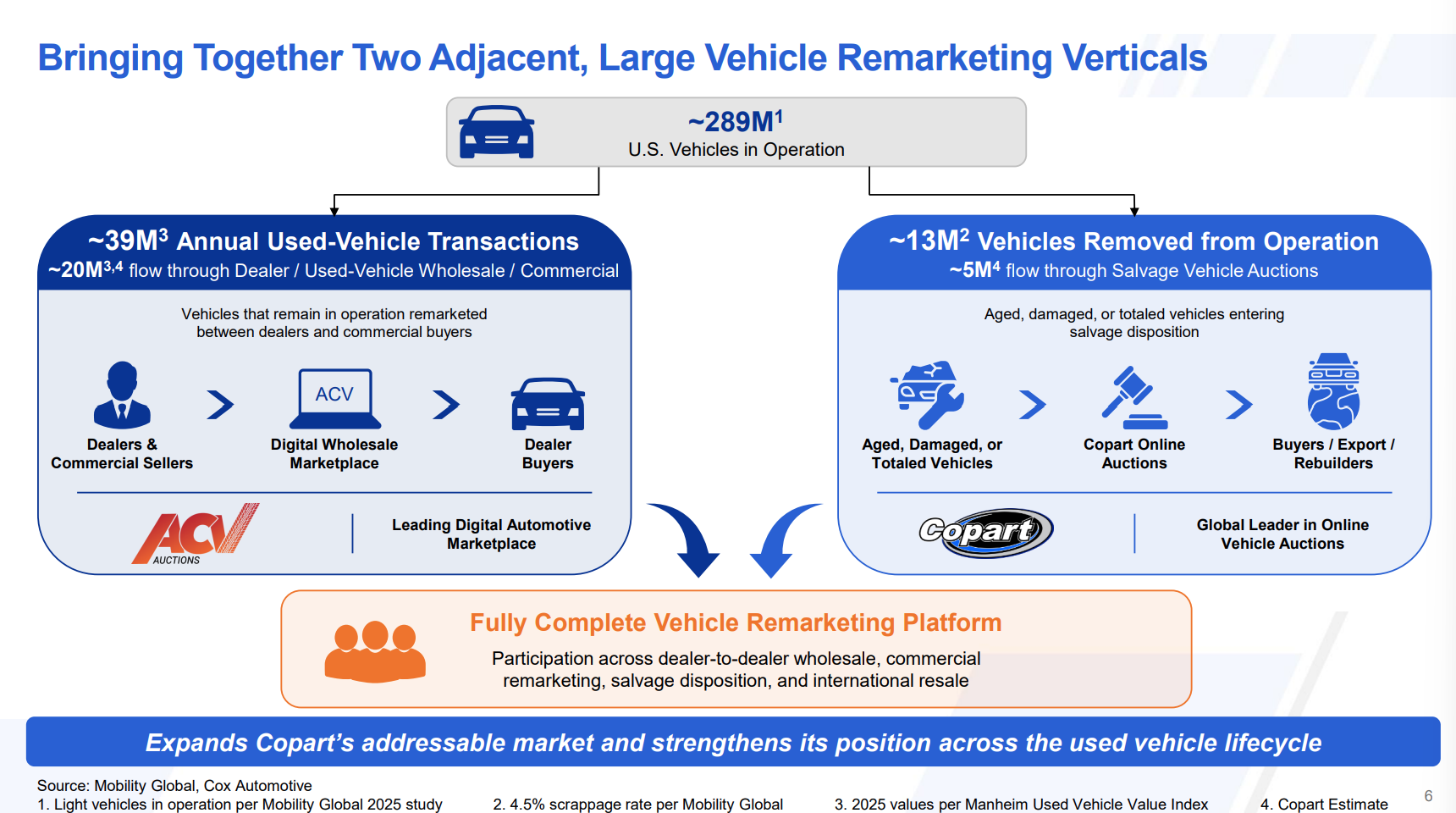
Complementary assets: ACV brings its extensive network and volume to Copart’s existing assets, allowing for a complete digital remarketing platform across trade-ins, wholesale, salvage, and international.
ACV can leverage Copart’s extensive network of physical assets. With no real home base, ACV must rely on dealers to house inventory. Copart can allow ACV to remove vehicles to its yards and free space on dealer lots (Adair noted they would create dedicated ACV areas in certain locations).
Copart gains additional volume for its international buyers and can leverage its existing infrastructure (moving 15,000 to 20,000 cars per day in the US alone).
Technology. Both companies have unique technology that’s worth more together. Essentially, it widens both sides of their respective networks with shared underlying logistics infrastructure.
Immediate presence in wholesale. Copart will have an immediate foothold in wholesale auctions. Already, 25% of Copart’s volume is from noninsurance BluCar (banks, rental fleets, and the like) and dealer services. ACV’s network is better suited to the types of buyers of these vehicles.
Culture. I was struck by the comments Adair made regarding ACV’s culture on its Q4 earnings call. He called them a scrappy, friendly bunch with a start-up culture. Just like Copart.
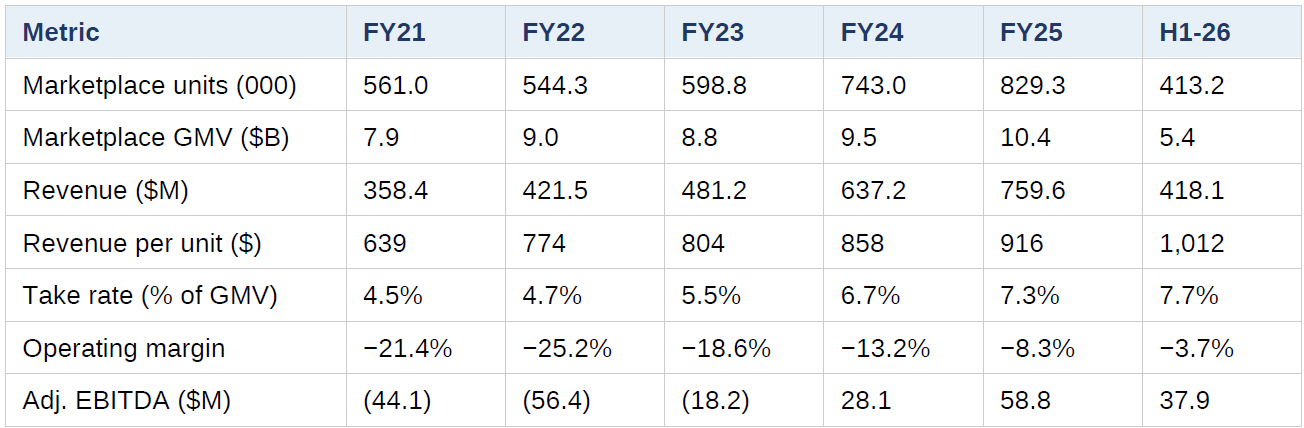
Growth Engine. The table below shows a clear progression of unit volume growth and revenue per unit growth. While ACV was founded in 2014 and has an accumulated deficit of half a billion dollars ($568 million to be exact), the trends are positive. Copart expects the acquisition to be neutral to earnings in FY 27 and accretive beginning in FY 28.
This slide from Copart’s Investor Presentation sums up the deal nicely:
Copart Q4 and FY 2026 Results
Jay Adair exuded confidence on the most recent conference call. Sure, results weakened in FY 26 (G&A ex. depreciation increased 7% for the year, and Q4 US operating margin fell five points, from 38.6% to 33.6%; US operating margin fell 110 bps, from 38.4% to 37.3% for the year), but there’s a clear sense that this is truly cyclical (insurance prices up > coverages down > Copart volume down) coupled with some one-off factors like the loss of assignments from Progressive. Excluding the single lost customer (cough: PGR), US insurance assignments would have been up 2.3%. Adair’s confidence in Copart’s ability to deliver comes through in his couched comments on IAA: “You either can generate the liquidity … that are going to bring the dollars in for the customer. Or you’ve just got to cut pricing dramatically… we don’t need to play that game.”
There’s also the matter of facility costs increasing 14% on a unit basis, which appears to be partly a result of Copart’s investment in long-haul delivery service. Adair pointed to a focus on reducing per-unit costs as a priority.
The other big plus: International units and revenue increased about 11% in Q4, and units increased 3.7% for the year, with Adair noting that all international markets are now profitable.
To sum up: global units fell 5.5% for the year, but revenue per unit increased 5.7%, leading to global revenues up 0.4% to $4.67 billion. Meanwhile, costs increased, partly due to investments, leading to a 2.6% decline in operating income to $1.65 billion; operating margin fell 110 bps from 36.5% to 35.4%. Net income declined 4.4% to $1.48 billion due to the lower operating income, a higher tax rate, and a one-time gain in FY 25.
The major capital allocation moves in FY 26 were $1.63 billion of buybacks and $87mm growth capex ($337mm gross).
On buybacks: There was no buyback activity in Q4. Given that shares trade at $32 vs. the $38 range where they bought back shares earlier, I’m wondering if management sees more M&A coming sooner rather than later.
Q4:
Revenue $1,152mm, +2.4% (service +1.4%; purchased vehicle sales +8.3%)
Gross profit $481mm, -5.5%; margin 41.8% vs. 45.3%
Operating income $369mm, -10.6%; margin 32.0% vs. 36.7%
Net income $327mm, -17.4%; diluted EPS $0.35 vs. $0.41 (Q4 FY25 had a $13mm one-time gain; lower interest income after buybacks)
US facility costs +7.7% (+14.2% per unit) on new services: long-haul delivery, Title Express, dedicated wholesale facilities
OpEx per car +12.7%; Adair says cutting it is a focus
FY 2026:
Revenue $4,666mm, +0.4% (+2.4% ex-FY25 hurricanes)
Gross profit $2,084mm, -0.8%; margin 44.7%
Operating income $1,653mm, -2.6%; margin 35.4% vs. 36.5%
Net income $1,484mm, -4.4%; diluted EPS $1.55 vs. $1.59
US facility costs -0.7% (+6.6% per unit)
Operating cash flow $1,604mm; gross capex $337mm (vs. $569mm)
Buybacks $1.63bn; $4.5bn cash/HTM securities, no debt
Volumes and other metrics (Q4 y/y unless noted):
Global units -2.9% (FY -5.5%; -3.1% ex-CAT)
US units -5.7% (FY -6.9%); International +10% (FY +3.7%)
US insurance units -7.5% (FY -8%). Ex-one lost customer, US insurance assignments would be +2.3%
US non-insurance units +0.2%, back to growth (FY -3.9%): dealer +5.8%, BluCar ~+20%, Copart Direct -11.7%
International insurance units +11.2%; International revenue +11.7%, op margin 25.6%
ASPs: global +3.5%, US insurance +3.7% (Manheim index +2.8%); global FY +5.5%
Revenue per unit +5.4% (FY ~+5.7%, per management); International fee revenue per unit +3.5%
Industry: collision claim frequency -3.4%; total loss frequency 23.3% (record calendar Q2); severity +8.8%
International buyers: 38.2% of US units, 45.7% of US dollars sold (FY26)
Impact on Valuation
Copart thinks it’s worth laying out $1.9 billion for ACV and understands its own return profile. Maybe it’s not going to earn 30% on capital, but even 20% (low for Copart standards) would need to produce almost $400 million in incremental EBIT to justify the purchase.
Things will look messy until the integration and synergies begin to accrue in FY 28. In my valuation framework, it’ll immediately add $1.9 billion to capital employed. This will cause lower capital turnover and margin, resulting in a temporarily depressed average ROCE for FY 27.
So where does that leave us for valuation? I’m leaving my previous analysis unchanged. Exchanging cash for a business simply changes the asset, and I’ll leave it at a 1:1 ratio for now until the facts dictate otherwise.
More thoughts? Let me know in a private message or leave a comment.
Stay Rational!
Adam
Order the 2nd Edition Now!
Praise for the 2nd Edition
I’m incredibly grateful for the people who took the time to review early drafts of the new material and provided feedback, as well as praise for both editions:
“If you want to understand how Warren Buffett built Berkshire Hathaway into one of the most valuable businesses in the world, you have to read this book. This is your opportunity to stand beside Picasso as he paints each brush stroke. A must read for all Buffett and Berkshire groupies.”
- Bill Ackman, Founder and CEO of Pershing Square
“I and my teammates at the Gabelli Organization have been tracking Warren’s success for some 50 years. Adam’s book captures the work and highlights the history of Berkshire and the hard and diligent work of Buffett and Munger, Jain and Abel, and Combs and Weschler.”
- Mario Gabelli, Chairman and CEO, Gabelli Funds
“Adam Mead’s discussion of the values and virtues which have shaped Berkshire Hathaway over 50 years is a must read for those investors in search of the forces that have delivered such investment value over time.” – Thomas A. Russo, Gardner Russo & Quinn LLC
“Few activities can be more rewarding for any value investor than studying the history and evolution of Warren Buffett and Berkshire Hathaway. Adam has done us a huge favor with his yeoman efforts in producing this treatise. Since it is chronologically ordered, it is an invaluable reference guide for all things Berkshire.” — Mohnish Pabrai
“Adam continues to deliver a resource very valuable to both Berkshire fans and the investor community as a whole, his depth of knowledge is clearly demonstrated here again. I thoroughly enjoyed this latest addition.” - Dan Calkins, Chairman & CEO, Benjamin Moore
“The question must be asked, ‘Why another Berkshire book?’ When you read this monumental effort by Adam Mead, the answer will be obvious. Read cover to cover, both the uninitiated to Berkshire and its most ardent followers will derive enormous utility and satisfaction from it. I learned so many new and important things about Berkshire and its history. It is my pleasure to encourage you to enjoy this gem.”
- Christopher P. Bloomstran
“Whatever Adam writes is always first-class - guaranteed.
-Andy Kilpatrick, Author, Of Permanent Value: The Story of Warren Buffett
I always admire managers who are willing to give up market share if they don't like the price. On the surface it looks like losing business but it's a better long-term decision for financials and reputation.